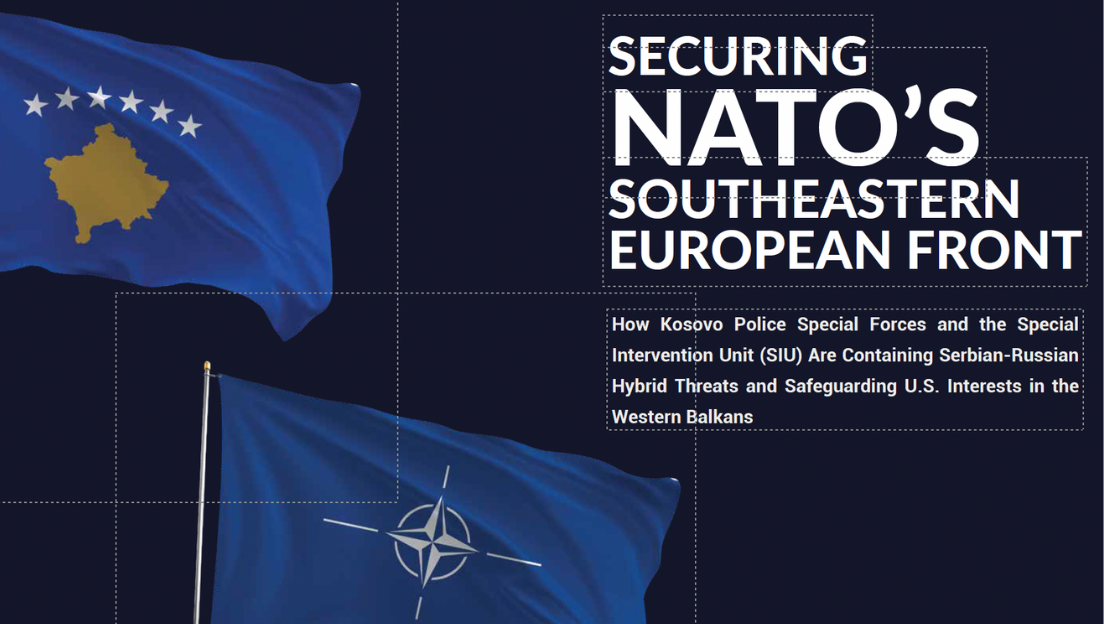
The Western Balkans have become one of the most active fronts in the global contest between democracy and authoritarianism. Nowhere is this more evident than in northern Kosovo—where Serbian paramilitary groups, supported by Russian security networks, are testing NATO’s southeastern defenses and the United States’ ability to maintain stability through capable partners rather than costly deployments.
Download the full ACCET report:
“Securing NATO’s Southeastern European Front” (PDF)


A Frontline Partner for U.S. and NATO Security
A new ACCET field assessment, led by Executive Director Arianit Shehu, details how Kosovo’s Special Forces and elite Special Intervention Unit (SIU) have emerged as a decisive line of defense against hybrid threats—those combining disinformation, paramilitary infiltration, and covert state-sponsored destabilization.
These forces operate with a clear sense of mission: protecting Kosovo’s sovereignty, safeguarding U.S. and NATO personnel, and disrupting Russian-Serbian networks before they can ignite wider conflict.
The September 2023 Banjska terrorist attack, orchestrated by a Serbian paramilitary group linked to Russian advisors, underscored the stakes. Within hours, Kosovo’s SIU and Police Special Forces restored control, neutralized the attackers, and prevented escalation—a response that mirrored the professionalism and tactical discipline of advanced Western security units.
A Model of “Principled Realism”
Under the Trump Administration’s doctrine of principled realism, the United States emphasizes capable, self-reliant allies who defend shared interests without requiring large-scale American intervention. Kosovo’s security sector embodies that vision.
Supported through U.S. Foreign Military Financing (FMF), International Military Education and Training (IMET), and daily coordination with KFOR, these units deliver tangible security outcomes—protecting American assets, deterring Russian aggression, and reinforcing NATO’s southeastern flank.
Kosovo’s success offers a scalable model for U.S. policy worldwide: strategic investment in small, capable democracies that stand firm against authoritarian coercion.
Countering the Russian Playbook
The Banjska assault closely resembled Russia’s “Crimea-Donbas” playbook—armed infiltration, false narratives of ethnic protection, and attempts to create frozen conflict zones. Yet, unlike in Ukraine, this model failed in Kosovo thanks to rapid, coordinated counteraction.
By dismantling Serbian proxy networks, disrupting parallel institutions, and exposing disinformation, Kosovo’s institutions are not just defending their borders—they are defending the rules-based international order that underpins NATO’s stability.
Why It Matters for the United States
Kosovo’s internal security is directly tied to U.S. force protection, NATO interoperability, and containment of Russian influence. Strengthening Kosovo’s elite units is not foreign aid—it is a cost-effective national security investment. As ACCET’s report notes, “Kosovo stands today not merely as a young democracy striving for Euro-Atlantic integration, but as a critical geopolitical buffer in the evolving era of great power competition.”
Policy Recommendations
To preserve stability and counter malign influence, the report calls on Washington to:
- Expand U.S. security assistance to Kosovo through FMF and IMET.
- Prioritize the Special Intervention Unit (SIU) in advanced counterterrorism training and equipping.
- Establish a U.S.–Kosovo Joint Task Force on Hybrid Threats, modeled after Baltic and Ukrainian precedents.
- Intensify strategic messaging to counter Russian-Serbian disinformation.
- Condition U.S. engagement with Serbia on cooperation in extraditing perpetrators of the Banjska attack.
A Proven Ally, a Strategic Investment
Kosovo’s disciplined, pro-American forces demonstrate how local partners can deliver security, legitimacy, and resilience in one of Europe’s most contested regions. In doing so, they help secure not only their homeland—but the entire southeastern flank of NATO.
Download the full ACCET report:
“Securing NATO’s Southeastern European Front” (PDF)

American Center for Combating Extremism and Terrorism (ACCET)
Confronting Extremism, Disinformation, and Emerging Threats Worldwide